
Money Matters: Building a Strong Financial Foundation
Money Matters: Building a Strong Financial Foundation
Financial wellbeing is one of the most significant, and most overlooked contributors to overall health and quality of life. When money feels uncertain or unmanageable it impacts more than just your bank account, it can affect your sleep, relationships and your ability to show up fully at work or at home.
This three-part series, Money Matters, is designed to change that, it offers practical, evidence informed guidance across the three building blocks of financial wellbeing.
This initial article begins with the basics - budgeting. It’s one of the most straightforward tools for establishing a solid financial foundation that aligns with the realities of your life. Once implemented, everything else becomes easier to manage.
Start with the basics:
1. List your income
Track your spending (you can download your transaction history if spreadsheets are your thing)
Compare income vs expenses
Budgeting Structure
Once you have a clear understanding of your income and expenses you can choose a budgeting structure that suits you. Below are some common structures that help you identify what might work for you.
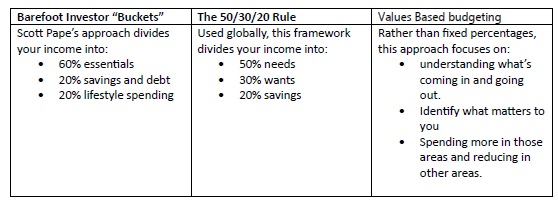
Some other helpful tips
Build around your baseline. If you are a shift worker with varied pay, budget based on the lowest reliable income and structure your essential expenses around that. Any extra income can be directed intentionally: into savings, reducing debt, or a spending buffer. This approach, sometimes called "baseline budgeting," is well suited to irregular earners because it eliminates the mental stress of recalculating every pay cycle.
Automate, automate, automate! One consistent research finding is that decision fatigue worsens financial outcomes. If you can automate your rent or mortgage payment, bills such as electricity, phone and internet and your savings on pay day, you reduce the number of decisions you have to make each pay period. That frees up space for everything else.
Build a small financial buffer. An emergency fund, even a modest one of $1,000 to $2,000, meaningfully reduces anxiety around unexpected bills. If that feels out of reach, start with $20 per pay period into a separate account you don't look at and let it accumulate over time.
Reflect your real-life priorities. Tailor your budget to your unique needs and values. Focus on what helps you recover physically and mentally from work and what adds the most value to your life. For example:
· Allocate funds for meal prep services or occasional takeaways during busy weeks.
· Prioritise family time with shared experiences or hobbies.
· Plan for irregular expenses like travel, birthdays, and special events.
A Note for Managers
Financial stress tends to be silent. People rarely disclose it, but it shows up as distraction, absenteeism, or low morale. As a team leader or manager, you don't need to become a financial counsellor, simply being aware that roster changes, delayed overtime processing, or unclear pay structures create genuine strain for staff is an important step in supporting their wellbeing.
Support and Resources
Taking control of your finances can have a positive impact on your overall wellbeing. Financial stress is often linked to increased anxiety, poor sleep, difficulty concentrating, and reduced mental wellbeing. The good news is that support is available.
MoneyFit Financial Coaching
Through MyWellbeing, you can access MoneyFit, a confidential financial wellbeing service designed to help you better understand your relationship with money and build practical skills around budgeting, debt management, saving, and financial planning.
Complete a MoneyFit Health Check to identify your money personality and access personalised coaching support tailored to your needs.
Check in with your wellbeing
Financial wellbeing is closely connected to both physical and mental health. If money concerns are affecting your sleep, stress levels, mood, or overall health, consider completing a Mental Health Screen or Physical Health Screen through MyWellbeing. These confidential assessments can help you understand how you’re tracking and connect you with appropriate support.
If your organisation has an Employee Assistance Program (EAP) with financial counselling services, proactively mentioning this during team conversations (not just in crisis situations) normalises the idea of seeking support early. Many EAPs include free, confidential financial counselling sessions.
You can also contact the National Debt Helpline (1800 007 007) for free, independent financial counselling from a qualified professional.
Wellbeing Services
If you’d like to speak with someone directly, Wellbeing Services is available to provide confidential support and guidance.
Phone: 08 8995 5422
Additional Support
If you need immediate support or would prefer to speak to someone outside of work, the following services are available 24/7:
• Lifeline: 13 11 14
• Beyond Blue: 1300 22 4636
• MensLine Australia: 1300 78 99 78
• National Debt Helpline: 1800 007 007[PF2]
Sources :
Donnelly, E. A., & Bennett, M. (2020). The effects of emergency medical service work on the psychological, physical, and social well-being of ambulance personnel: a systematic review of qualitative research. BMC Psychiatry, 20, 348. https://doi.org/10.1186/s12888-020-02752-4
H&R Block Australia. (2024). How to budget with an irregular income. https://www.hrblock.com.au/tax-academy/budgeting-irregular-income
Mani, A., Mullainathan, S., Shafir, E., & Zhao, J. (2013). Poverty impedes cognitive function. Science, 341(6149), 976–980. https://doi.org/10.1126/science.1238041
Paytime. (2026). Solving attendance and shift gaps through financial wellbeing. https://www.paytime.com.au/attendance-and-shift-filling/
PwC. (2023). Employee financial wellness survey. PricewaterhouseCoopers.
TIAA Institute & High Lantern Group. (2024). Financial stress and mental health: Implications for employee engagement. TIAA Institute.